Resumo De Livro: Talking with humans (Giff Constable, Tom Fishburning, Frank Rimalovski)
2026-03-19
Este é um resumo adaptado para revisão futura. O método de escrita é ortodoxo.
Nota: 4/10
Dificuldade: Fácil
Published on 2014
SUMMARY
Stay outside of the building, customers will be there, book The Four Steps to the Epiphany and Lean Startup, meanwhile, walk around outside with the wrong question, will not help, do not ask for the customer the obvious
Many entrepreneurs “get out” and get in front of customers, but take a simplistic view and ask their customers what they want, or if they would buy their startup’s (half-baked) pproduct.
The “getting oit” part is easy. It is the application of the customer development methodology and the testing of their hypotheses with users, customers and partners that is both critical and often difficult for entrepreneurs to grasp in the search for a scalable and repeatable business model.
Giff Constable’s blog post “12 Tips for Early Customer Development Interviews” required reading.
Talking to Humans teaches you how to get out of the building.
It guides students and entrepreneurs through the critical elements:
-
how to find interview candidates
-
structure and conduct effective interviews
-
synthe-size your learning
Steve Blank 2014-09-03
01-introduction
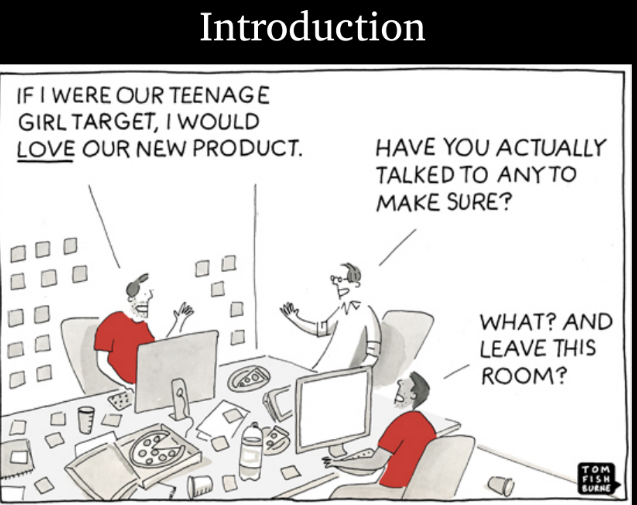
Balance of vision and reality, risk management at the beginning
Steve Blank’s advice: “Get out of the building!”
-
talk directly to your customers and partners, and observe their behavior;
-
run experiments in which you put people through an experience and track what happens.
Book focus on method 1
Here’s what customer discovery is not
-
It is not asking people to design your product for you.
-
It is not about abdicating your vision.
-
It is also not about pitching.
A natural tendency is to try to sell other people on your idea, but your job in customer discovery is to learn.
Find standards to take better decisions
I urge you to be brave, get out of the building, and go talk to real human beings.
Giff Constable - 2014-08
02-the-story
tp - Breakthrough - Ruptura das linhas inimigas
Koshi and Roberta, artificial feathers for pillows, sustainable, more resilience and resistance, but:
The question now is: do they have a business?
Samantha, business advisor, helps Koshi and Roberta.
Samantha mission for them:
“I want you to get ahead of the risky hypotheses that might cause failure.”
-
We believe that people care about sleep quality when making a pillow purchase decision.
-
We believe that we can sell online directly to customers.
-
We believe that our customers will be young urban professionals.
-
We believe that our very first customers will be new graduates who need to outfit their apartments.
-
We believe that we can sell our pillows at a high enough price to cover our costs.
-
We believe that we can raise enough capital to cover investments in manufacturing.
Strategy:
…walk a day in your customer’s shoes and actually go out and buy a pillow.
Second, I want you to observe people in the process of buying a pillow.
And third, I want you to talk directly to them.
Make an interview, but don’t with people so close of you, pay attention on the persona
tp - interview plan
Intro: Hello, I’m a PhD candidate at Hill-side University and I’m researching sleep quality.
I’m asking people about the last time they bought a pillow. Would you mind if I asked a few questions?
When was the last time you bought a pillow?
Why did you go looking for a pillow?
How did you start shopping for a pillow?
Why did you choose the one you bought?
After you bought, how did you feel about the pillow you purchased?
Are you going to be in the market for a pillow anytime soon?
tp - Walking in the Customer’s Shoes
Online research, ux and ui, reviews, categories, navigation
tp - Observing the Customer
Roberta observed customers on Bed Bath & Beyond and had a conversation with Ms. Susan, that the first action was an online search, bought 1 pillow and make another purchase because she likes a lot of the pillow acquired
Koshi research was on a local store, together they got a standard:
-
24% of shoppers knew what they wanted when they walked in
-
52% looked up information on their phone in the store
-
45% of shoppers purchased a midpriced or high-priced pillow
-
68% of the people we spoke to indicated that better sleep was a major driver of their choice
-
37% of the people we spoke to were reacting to a life change
-
37% of the people we spoke to were in replacement mode
tp - Regrouping
Koshi, interview with college youngers youngers, they don’t care too much about pillow quality, preference for the cheapest when buy or use a old
linens - lençóis
I spoke to twelve people between 22 and 25, and roughly 60% had actually bought a pillow in the last few years.
72 people universe set
Samantha’s review:
tp - Challenging Assumptions
Numbers it is not so important, but helps.
1. We believe that people care about sleep quality when making a purchase decision
“68% of the retail shoppers indicated that this was a major factor,” said Roberta.
“Of our young urban professionals, we were able to ask this of only a portion of our interviewees. Only 56% indicated that it was a factor, but if we factor out the new graduates, it was more like 70%. We’ve also read a lot of online reviews and have seen this come up repeatedly. We feel reasonably confident that this is a common decision point in choosing a pillow”, said Koshi.
2. We believe that we can sell online directly to customers.
“77% of our urban professionals start researching purchases with a search engine. The question is whether they would discover, visit, or convert with our online store. We did see a ton of mobile usage in the retail stores and think there might be a chance to steal those customers if we have good enough search engine optimization. Overall, our conclusion is that we need moredata here.”
3. We believe that our customers will be young urban professionals.
“I need to run some numbers on size of market and the number of purchases we might expect from this group, but we still feel like this is a good group for us. We clearly saw purchase behavior. They want, and can afford, quality things, and prefer to buy things online.”
4. We believe that our very first customers will be new graduates who need to outfit their apartments.
“This is where we were totally wrong”
Buying behavior, or at least the willingness to buy something that iis’t the cheapest option, did not seem to be very prevalent among new grads. Only 25% of the newly minted grads we spoke with had purchased a pillow on their own. Instead, the evidence points us towards people in their mid-to-late twenties or early thirties.
“We also saw a correlation between purchasing and life changes. While this was only 37% with our retail shoppers, it was 70% of our urban professionals. From an early adopter perspective, I wonder if we can do well targeting people who are getting married or moving to a larger apartment or house?”
5. We believe we can sell our pillows at a high enough price to cover our costs.
“45% of our retail shoppers bought at least a mid-priced pillow. We admit that we visited reasonably high-end stores, but that was still a nice statistic to see. The good news is that our initial target price is comparable with the high-end of the current market. We won’t be profitable at the beginning, but if we can scale and improve our manufacturing process then we can move into the black. Of course, they have to want to buy our pillow.”
Samantha suggests to them, sell some units for the risk group segmentation, worried about profitability
tp - Lessons Learned

So what are the key takeaways from Roberta and Koshi’s adventure?
-
Customer discovery is about gaining much deeper insight into your customer, or your partners, or your market
-
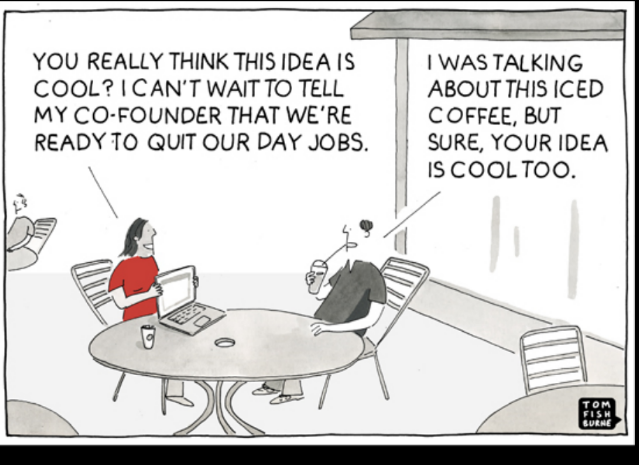
Being told your idea is cool is not useful; seeing behavior that validates your customer’s willingness to buy is very useful
willingness - disposição
-
Prepare an interview guide before you get out of the building
-
To ask the right questions, you need to understand your risks and assumptions
-
Get creative when trying to recruit people - if at first you don’t succeed, try something new
-
Sometimes observation is as powerful as interviews
-
Take good notes, especially on your key risks, so that you can calculate metrics later. Even better, set your target goals ahead of time!
-
Bring learning back and analyze your patterns as a team
-
Never stop asking hard questions about your business
03-how-to
tp - Getting Started with Customer Discovery
Do always, method:
-
Who do you want to learn from?
-
What do you want to learn?
-
How will you get to them?
-
How can you ensure an effective session?
-
How do you make sense of what you learn?
tp - Who Do You Want to Learn From?
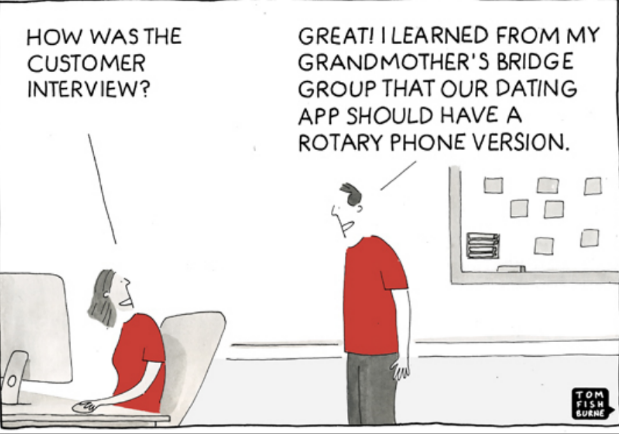
Talk with the desired customer (ICP - Ideal Customer Profile)
-
The typical customer you envision if you get traction with your idea
-
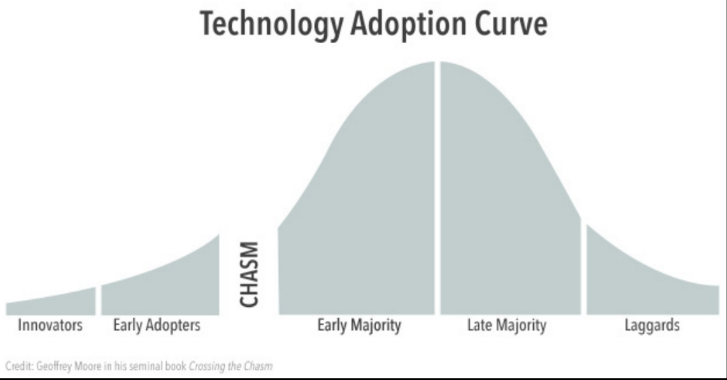
Your early adopter, i.e. the people who will take a chance on your product before anyone else
-
Critical partners for distribution, fulfillment, or other parts of your business
Be specific, don’t make a product or service for everybody, focus on ICP, customer base segmentation
commonalities - características comuns
tp - technology adoption curve
Special Note for B2B Products
In a classic enterprise sale, you will often have:
a strategic buyer (who is excited about the change you can bring)
an economic buyer (who controls the purse)
a technical buyer (who might have approval/blocker rights)
and then the actual users of your product.
Can you identify your champion? Can you identify who might be a saboteur?
For B2B companies, Steve Blank also recommends that you start by talking to mid-level managers rather than the C-suite. It can be easier to get their time, it is often easier to get repeat conversations, and, most importantly, it will allow you to get better educated before you go up the chain.
tp - What Do You Want to Learn?
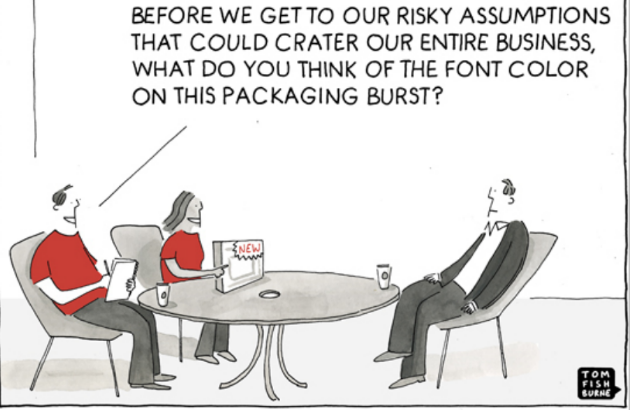
Be prepared with questions before the meeting, you can create yours questions based on 2 points:
-
most important thing to the business
-
most risky thing to the business
Attention, the customer point of view is together with the ideation
You can use Alex Osterwalde’s business model canvas or Ash Maurya’s lean canvas.
Examples
-
My target customer will be?
-
The problem my customer wants to solve?
-
My customer’s need can be solved with?
-
Why can’t my customer solve this today?
-
The measurable outcome my customer wants to achieve is?
-
My primary customer acquisition tactic will be?
-
My earliest adopter will be?
-
I will make money (revenue) by?
-
My primary competition will be?
-
I will beat my competitors primarily because of?
-
My biggest risk to financial viability is?
-
My biggest technical or engineering risk is?
-
What assumptions do we have that, if proven wrong, would cause this business to fail? (Tip: include market size in this list)
Answers examples
-
Pet owners are frustrated having to go to a vet and would rather have someone come to them
-
Customers are willing to pay a big premium to have a vet show up at their door
-
We think busy urbanite pet owners will be our early adopters
-
We think people currently discover their vets either through word of mouth or online searches
-
We can affordable acquire our customers through targeted Google search ads
-
We can recruit enough vets across the country to make this a big enough business
-
With travel baked in, our vets can see enough people in a day to be financially viable
Not every assumption can be tested effectively through qualitative research, but in this case, our founders can probably get some insights on risks 1, 3, 4, and 6 just by talking to people.
Risks 1, 3 and 4 would be focused on pet owners, while #6 would be focused on vets.
tp - Get Stories, Not Speculation
Be careful with speculation, humans are bad with future predictions
It is more effective to ask your interview subject to share a story about the past.
For example, when our fictional scientists Koshi and Roberta created their interview plan, the questions were focused on getting the interviewee to tell a story about their last pillow buying experience.
Example with vet
-
Warm up: concise intro on the purpose of the conversation
-
Warm up: basic questions about person and pet (name, age, picture)
-
Who is your current vet? Can you tell me about how you found and chose him/her?
-
Please describe the last time you had to take your pet to the vet for a checkup
-
Walk me through the process of scheduling a time to visit the vet
-
What was frustrating about that experience?
-
What did you like about that experience?
-
Have you ever had an emergency visit to a vet? if yes, can you describe that experience for me?
-
Have you ever thought about changing vets? why/why not?
tp - Ask Open-Ended Questions
Open ended questions, or open or with yes/no with a open question
To that end, it is imperative that you structure open ended questions, or at minimum follow up yes/no questions with an open ended question that gets them talking.
One tip is to try to ask questions that start with words like who, what, why and how.
Avoid questions that start with is, are, would, and do you. But remember, if you do get a yes/no answer to a question, you can always follow up in a way that gets them talking.
End question
“What should I have asked you that I didn’t?”
tp - Testing for Price
My note: You can test with a table of prices and ask too
Two of the hardest questions to answer through qualitative research are: will people pay? and how much will they pay?
Questions
-
How much do you currently spend to address this problem?
-
What budget do you have allocated to this, and who controls it?
-
How much would you pay to make this problem go away? (this can lead to interesting answers as long as you don’t take answers too literally)
…set up a situation where the subject thinks they are actually buying something, even if they know the thing doesn’t exist yet. Kickstarter and other crowdfunding platforms are used by a lot of teams to test pre-order demand.
tp - Getting Feedback on a Prototype
Ask your questions about behavior and challenges first, so that the discussion about product features does not poison or take over the conversation.
People do love talking features!
tp - The Magic Wand Question
Avoid questions like:
“If you could wave a magic wand and have this product do whatever you want, what would it do?”
Because, a customer could be focused on your scope (bubble), that obfuscated your view for a solution
An effective question instead:
“If you could wave a magic wand and solve any problem, what would you want to solve?”
tp - Design “Pass/Fail” Tests
Customer discovery is made up of a lot of qualitative research, but it helps to take a quantitative mindset.
-
24% of shoppers knew what they wanted when they walked in
-
45% of shoppers purchased a mid-priced or high-priced pillow
-
68% of the shoppers we spoke to indicated that better sleep was a major driver of their choice
Even better would have been if they had set targets ahead of time. For example, they might have set the following goals:
-
Because we are a new brand, we are hoping that most shoppers are undecided. We want to see that 40% or fewer shoppers already know what they want when they walk in
-
Because our pillow is expensive, we want to see that at least 40% of the shoppers buy mid or high-end models
-
Because we believe that sleep quality is a major differentiation for our product, we want over 60% of shoppers to indicate that this is a major factor in their decision making process
tp - A Guide, Not a Script
To veer of - mudar de assunto
Flexibility with the research, the guide is a support, not a rule
tp - Observation Can Be As Powerful As Questions
This technique cannot always be used.
For example, when my team was trying to validate a weight loss product idea, it did not feel practical to watch people go about their diet.
Instead we did interviews and then put a group of customers through a two-week concierge experiment (see Glossary) where we manually acted out the diet experience.
But, where possible, observing uninfluenced behavior can lead to great insights.
tp - How Do You Find Your Interview Subjects?

People like to help when the theme ate important for them.
-
Try to get one degree of separation away (don’t interview your mom, your uncle, or your best friends)
-
Be creative (and don’t expect people to come to you)
-
Fish where the fish are (and not where they are not)
tp - Get Creatve
One aspiring entrepreneur wanted to target mothers of young children. She had heard stories about talking to people in a coffee shop, but felt like it was too unfocused. So she tried hanging around school pickup zones, but the moms were too busy and refused to speak to her.
Next, she tried the playground, where she figured moms would be bored watching their kids play. This worked reasonably well, but she was only able to get a few minutes of anyone’s time.
So instead, she started organizing evening events for moms at a local spa where she bought them pedicures and wine. The time of day worked because the moms could leave the kids at home with their partner.
The attendees had a great time and were happy to talk while they were getting their nails done.
tp - Find the Moment of Pain
If you can connect with people at the moment of their theoretical pain, it can be very illuminating.
My colleague Alexa Roman was working with an automotive company and they had a concept tied to the experience of getting gas. So Alexa and team visited a series of gas stations. They watched consumers go through the process of buying gas.
Then they approached them and asked questions. By thinking about the moment of pain they wanted to address, they knew exactly where to find their consumers and they were able to gather valuable observational research.
tp - Make Referrals Happen
Use referrals to your advantage. Let’s say you want to talk to doctors. They are busy and have strong gatekeepers. I bet you know how to get to at least one doctor, however.
That doctor will know other doctors. Even if your doctor happens to be a close friend and thus breaks the “more than one degree of separation” guideline, she can still give you advice on when might be a good time to talk to a doctor.
She can also connect you with other doctors.
You should use referrals as much as possible. Set a goal of walking out of every interview with 2 or 3 new candidates. When you end an interview, ask the person if they know others who face the problem you are trying to solve.
If they feel like you have respected their time, they will often be willing to introduce you to others.
tp - Conferences & Meetups
Conferences and meetups can be an amazing recruiting ground, because they bring a group of people with shared interests into one place. You just need to be respectful of people’s time. I have found that it is extremely effective to ask people for their time, but for later, after the conference or meetup.
Get their business card, let them get back to networking, and then have an in depth conversation when it fits their schedule.
Immediately after the conference while their memories are still fresh, send them a short email that reminds them where you met, and give your ask for a conversation. This works as effectively for in demand panel speakers as it does for other attendees.
Meetups are usually inexpensive, but conference tickets can be pricey. If you are on a budget, you can “hack” expensive conferences by intercepting people outside of the building, or, if you can get access to the attendee or speaker lists ahead of time, contacting people directly and meeting them near the event.
Meetup.com has decent search tools to discover relevant events in your area, and a few good Google search queries can usually get you to a short list of conferences that fit your needs.
tp - Enterprise Customers
Finding interviewees can be harder when you are focused on an enterprise customer. You need laser-like targeting. In addition to conferences, LinkedIn can be extremely useful.
If you have hypotheses on the titles of the people you are seeking, run searches on LinkedIn. You might be able to get to them through a referral over LinkedIn, or you might need to cold call them through their company’s main phone number.
You then have to decide on your approach method. You can either ask for advice (where you make it clear that you are not selling anything), or you can go in as if you were selling something specific.
tp - Advice vs Selling
Asking for advice should be your default method early in your customer discovery process.
You will have better luck gaining access. People like being asked (it makes them feel important).
Steve Blank used to call people up and say something like, “My name is Steve and [dropped name] told me you were one of the smartest people in the industry and you had really valuable advice to offer. I’m not trying to sell you anything, but was hoping to get 20 minutes of your time.”
Another effective spin on “asking for advice” is to create a blog focused on your problem space, and ask people if you can interview them for an article.
When do you approach someone as if you were selling a product? This method is useful if you are past initial learning and want to test your assumptions around customer acquisition and messaging. Just don’t jump into sales mode too early.
tp - Benefiting from Gatekeepers
If LinkedIn isn’t helping you and you need to reach high up in an organization, another approach is to call the CEO’s office.
Your goal is not to talk to the CEO but actually their executive assistant. His job is to be an effective gatekeeper, so if you explain, “I’m looking to talk to the person who handles X”, they will often connect you to the right person (especially if you are pleasant and professional - notice the trend on that one?).
The added advantage of this method is if you end up leaving a voice mail for your intended contact, you can say “Jim from [CEO’s name]’s office gave me your name”.
Dropping the boss name tends to improve response rates.
Another approach is to send a targeted email into an organization with a very short email that asks for an introduction to the right person to speak to. You can make guesses as to email addresses based on LinkedIn queries. For this tactic to work, you must keep your emails extremely concise.
tp - Students and Researchers
While people are willing to grant time to polite people who ask for advice, you have an extra advantage if you are a student or academic researcher.
In other words, if you are a student or researcher, say so. As an extra incentive, you might also offer to share the results of your research with your interview subjects.
tp - You Might Be Surprised
Another colleague of mine, Jonathan Irwin, was working with a Fortune 50 company.
The client team wanted to interview a special kind of oil platform engineer, of which there were less than 20 in the world! To access these people required security clearance and safety training.
We challenged the team to find a way, expecting that they would have to rely on video conferencing or phone calls. However, the team started researching this specialty profession through Google and discovered that there was an onshore training facility just an hour away.
The moral of the story is that it often isn’t as hard as you think.
tp - No Fish in the Sea
When I say fish where the fish are, it is really important to remember the flip side to that statement: don’t fish where the fish are not.
If a method isn’t working, try something new.
We were doing a project with a major magazine testing out new product ideas. Our target was busy women, and we knew that the readership correlated closely with shoppers of The Container Store (a retail store).
So we parked out front of a store and intercepted folks as they came in and out. People were willing to speak for a few minutes, but many were in a bit too much of a rush.
Then one of our teammates discovered a sample sale happening around the corner. There were probably 200 bored women waiting in line, most of whom were happy to talk to us to pass the time. (Note: finding bored people stuck in line is a common recruiting hack.)
Still, we didn’t feel like we were targeting quite as narrowly as we wanted (busy, working women) or as geographically broadly (we didn’t want to just talk to New Yorkers).
So we turned to the magazine’s social media presence. We created a short online survey to help us qualify responses, and the magazine posted a link to their Twitter and Facebook pages with a catchy sentence. We had hundreds of women fill out the survey, and then we picked our top thirty candidates and scheduled calls.
tp - Online Forms & Landing Pages
In a similar vein, one effective tactic is to create an online form or landing page and build up a list of people to contact.
Below is an example of a landing page. Our team was testing a product idea for better home organization.
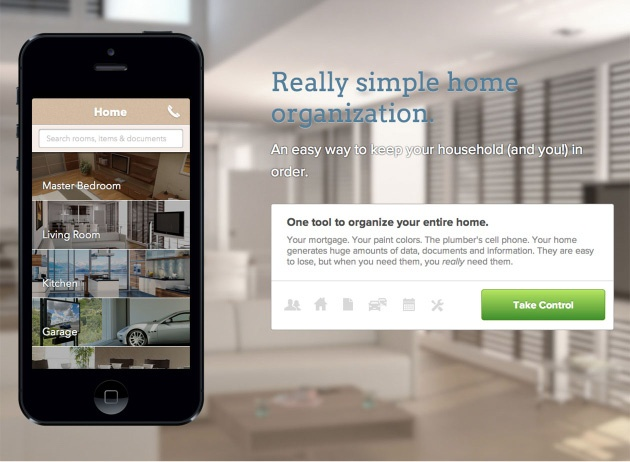
This landing page test actually consisted of a three step funnel with a call to action, a price choice, and then a request for an email address.
We tracked the conversion metrics carefully and used the emails to schedule interviews.
Caveat: driving traffic is never a trivial process. If you have budget, Google or Facebook ads can work. Otherwise, you can try to generate some word of mouth on social media or through bloggers.
tp - Conclusion
Hopefully what you are picking up through these examples is that there is no single way to get to people. It takes some creativity and hustle, but it isn’t as hard as you might think.
Trust me, people will not think you are rude if you carry yourself well and act professionally.
tp - How to Ensure an Effective Session?
tp - Do Your Interviews In Person
Scale of best interview methods
on person, video call, phone, form
tp - Talk to One Person at a Time
You make the interview, another person takes notes, ask for recording if possible, but remember that a mic or camera can inhibit the conversation
tp - Start With a Warm Up & Keep It Human
1 or 2 questions to break the ice
tp - Disarm Your Own Biases
Antagonist with your bias,.confirmation bias
tp - Get Them to Tell a Story
Do not ask for the person behavior, discover how they think about the problem:
What triggered their search for a solution?
How did they look for a solution?
What did they think the solution would do, before they tried it?
How did that particular solution work out?
And if they are struggling to remember specifics, help them set the scene of their story: what part of the year or time of day?
Were you with anyone?
tp - Look for Solution Hacks
People persistent to solve the problem, there is an opportunity
tp - Understanding Priority
Rank the pain
tp - Listen, Don’t Talk
You are learning, not selling
don’t embed the answer you want to hear into the question
tp - Follow Your Nose and Drill Down
Don’t be afraid to ask for clarifications and the “why” behind the “what”.
tp - Parrot Back or Misrepresent to Confirm
For important topics, try repeating back what the person said. You can occasionally get one of two interesting results. They might correct you because you’ve misinterpreted what they said. Or, by hearing their own thoughts, they’ll actually realize that their true opinion is slightly different, and they will give you a second, more sophisticated answer.
Another approach is to purposefully misrepresent what they just said when you parrot it back, and then see if they correct you.
But use this technique sparingly, if at all.
tp - Do a Dry Run
Test before with a colleague your interview to break the ice
tp - Getting Feedback on Your Product
separate the storytelling part of your session from the feedback part
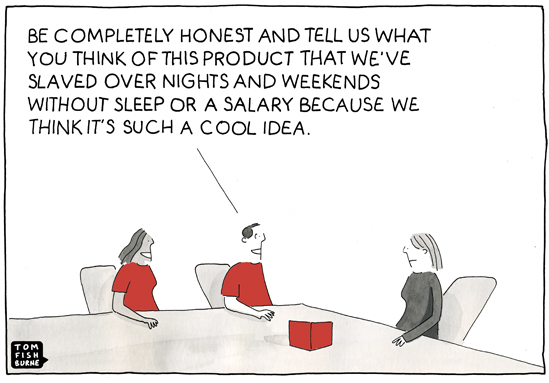
Second, disarm their politeness training. People are trained not to call your baby ugly.
You need to make them feel safe to do this. Ask them up-front to be brutally honest, and explain that it is the very best way for them to help you. If they seem confused, explain that the worst thing that could happen is to build something people didn’t care about.
tp - How Do You Make Sense of What You Learn?
Your goal is not to learn for learning’s sake. Your goal is to make better decisions that increase the odds of success
tp - Take Good Notes
A partner to take notes, write during the interview, make them available to the team soon as possible, example of note:
-
Name of interview subject
-
Date and time
-
Name of interviewer
-
In person or video conference
-
Photo (if you have one)
Then at the start of your notes, include basic descriptive information of the interview subject.
tp - Quantitative Measures
If you are setting specific metric goals for your interviews, you might set up a shared spreadsheet that essentially acts as a running scorecard for how you are doing and how you are tracking to targets.
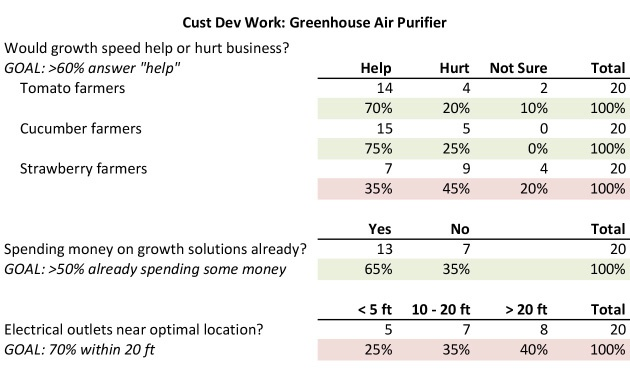
Let’s imagine that you have invented a new air purifier that triples the growth speed of greenhouse plants. Now you plan to talk to 20 farmers, and you have a few core questions:
-
Will their business actually benefit from increased growth speed? You are assuming that increased volume will help rather than hurt. You plan to talk to growers of different crops with the goal of finding crops where 60% or more of farmers want increased volume.
-
Are farmers spending any money today on growth accelerator solutions? Your qualitative research will drill into what and why, but your metrics goal says that you hope at least 50% of the market is already spending at least some money.
-
Do they have the facilities to support your purifier? In this case, you need your purifier to be both in a specific location, but also have access to an electrical outlet. You are hoping that 70% of the farmers have an outlet 20 feet or closer to your spot.
Here is the kind of spreadsheet that you and your team might track:
tp - Dump and Sort Exercise
Bring your team together and arm them with sticky notes and sharpies.
Give everyone 10 minutes to jot down as many patterns and observations as they saw during their interviews. Put all the sticky notes on a wall and have someone sort them into groups.
As a team, discuss the patterns, and then re-review your assumptions or business canvas and see what might need to change or require greater investigation.
tricky - complicado
to be bogged down - estar atolado
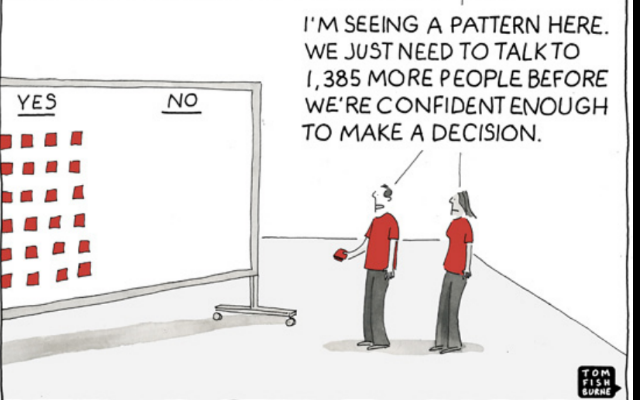
Customer development interviews will not give you statistically significant data, but they will give you insights based on patterns. They can be very tricky to interpret, because what people say is not always what they do.
You don’t want to react too strongly to any single person’s comments. You don’t want to take things too literally. But neither do you want to be bogged down trying to talk to thousands of people before you can make a decision.
You need to use your judgment to read between the lines, to read body language, to try to understand context and agendas, and to filter out biases based on the types of people in your pool of interviewees. But it is exactly the ability to use human judgment based on human connections that make interviews so much more useful than surveys.
tp - Don’t Abdicate Your Role As Product Designer
It is not the job of the customer to design your product. It is yours. As you are gathering information and making decisions, act like a intelligent filter, not an order-taker.
tp - Expect False Positives
While all entrepreneurs get their fair share of naysayers and skeptics, you have to be wary of the opposite problem in customer development interviews.
People will want to be helpful and nice, and your brain will want to hear nice things. As you are weighing what you have learned, just keep this in mind.
tp - The Truth Curve
Balance between talk with customer to get qualitative data and get quantitative data with commons metrics.
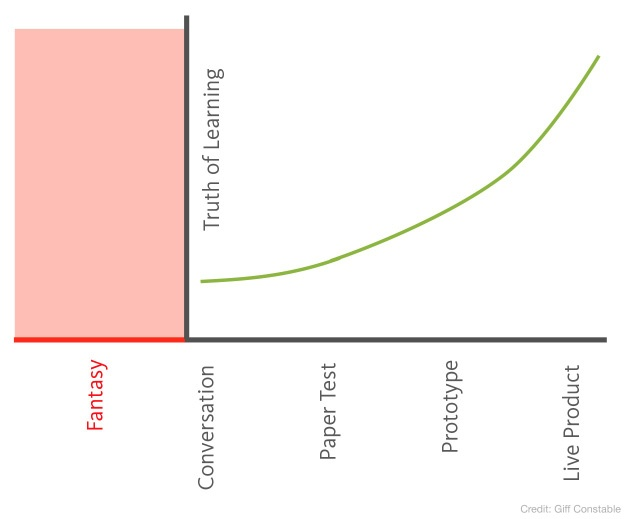
Talking to people is powerful. It tends to give you your biggest leaps of insight, but, as I keep on repeating, what people say is not what they do.
You might show people mockups, prototype and a mvp that might give you another level of learning and feedback.
tp - How many people to talk to?
There is no pat answer to this question. A consumer business should talk to an order of magnitude more people than a business that sells to enterprise.
If you are in the consumer space and haven’t spoken to at least 50 to 100 people, you probably have not done enough research.
In his I-Corps course, Steve Blank requires his teams, many of which are B2B, to talk to at least 100 people over 7 weeks.
I advise that you never stop talking to potential customers, but you will probably evolve what you seek to learn.
If you see the same patterns over and over again, you might change things up and examine different assumptions and risks. For example, if you feel like you have a firm understanding of your customer’s true need, you might move on to exploring how they learn about and purchase solutions in your product category today.
And don’t forget that observing your customers can be as powerful as directly talking to them.
tp - Lead with Vision
Customer Development and lean startup techniques are some of the most powerful ways to increase your odds of success, but they are not a replacement for vision.
You need to start with vision. You need to start with how you want to improve the world and add value to people’s lives. The techniques we’ve discussed in this book are among a body of techniques that let you reality check your vision, and optimize the path you will take to achieve your vision.
04-conclusion
though - no entanto
thought - pensamento
thoughtful - considerado
thoughtfulness - consideração
thoughtfully - pensativamente
Creating a new business is tremendously challenging. The ways you can fail are numerous.
-
You have to get the customer and market right
-
You have to get the revenue model right
-
You have to get the cost structure right
-
You have to get customer acquisition right
-
You have to get the product right
-
You have to get the team right
-
You have to get your timing right
Screw up any one of those and you are toast. There is a reason why entrepreneurship is not for the faint of heart.
But we’re not here to be faint of heart. We are here to change the world.
Appendix
tp - Cold Approach Examples
When you are trying to reach someone you do not know, there are a few things to remember:
-
Keep things concise
-
Keep things convenient (meet near their office, etc)
-
Name drop when you can
-
Follow up if you don’t hear an answer, but don’t be annoying
-
If you are leaving a voice mail, practice it first (you might think it sounds practiced, but to others, it will sound more professional)
Example Email 1
To: john.smith@mayflower.com
From: me@me.com
John,
I received your name from James Smith. He said that you had a lot of expertise in an area I am researching and recommended that we speak.
I’m trying to study how companies are handling their expense report management workflows and the frustrations they are experiencing. I would be happy to share my research conclusions with you.
Would you have 30 minutes to spare next week when I could buy you a cup of coffee and ask you a few questions?
Many thanks for your time and I look forward to hearing from you,
Jane Doe
Example Email 2
To: john.smith@mayflower.com
From: me@me.com
John,
I have been working on some new solutions in the area of expense report management, and I was told that you have a lot of expertise in this area.
We started this journey because of personal frustration, and we’re trying to figure out how to make expense reporting much less painful. Would you have 30 minutes to give us some advice, and share some of your experiences in this domain?
I assure you that I’m not selling anything. I would be happy to come by your office or arrange a quick video conference, at your preference.
Many thanks,
Jane Doe
Example Voice Mail Message
“Hello, my name is Jane Doe. I was referred to you by James Smith, who said I would benefit from your advice. I am currently researching how companies are handling their expense management workflows. I understand you have a lot of expertise in this area. I was hoping to take just 30 minutes of your time to ask you a few questions. I’m not selling anything and I would be happy to share my research conclusions with you. You can reach me at 555-555-5555. Again, this is Jane Doe, at 555-555-5555, and thank you for your time.”
Final Note
Cold calling is never anyone’s favorite thing to do, but it isn’t nearly as painful as you imagine. You have nothing to lose and everything to gain. So give yourself a determined smile in the mirror, and go get them!
Business Assumptions Exercise
I am agnostic about the framework you choose to use to map out your business assumptions.
Alexander Osterwalder’s business model canvas and Ash Maurya’s lean canvas are both powerful tools. I also often find myself using this simple set of questions to lay out a belief system around an idea:
Try to make your assumptions as concise and specific as possible. You want to be able to run an experiment against it to see if it is true.
My target customer will be?
(Tip: how would you describe your primary target customer)
The problem my customer wants to solve is?
(Tip: what does your customer struggle with or what need do they want to fulfill)
My customer’s need can be solved with?
(Tip: give a very concise description / elevator pitch of your product)
Why can’t my customer solve this today?
(Tip: what are the obstacles that have prevented my customer from solving this already)
The measurable outcome my customer wants to achieve is?
(Tip: what measurable change in your your customer’s life makes them love your product)
My primary customer acquisition tactic will be?
(Tip: you will likely have multiple marketing channels, but there is often one method, at most two, that dominates your customer acquisition - what is your current guess)
My earliest adopter will be?
(Tip: remember that you can’t get to the mainstream customer without getting early adopters first)
I will make money (revenue) by?
(Tip: don’t list all the ideas for making money, but pick your primary one)
My primary competition will be?
(Tip: think about both direct and indirect competition)
I will beat my competitors primarily because of?
(Tip: what truly differentiates you from the competition?)
My biggest risk to financial viability is?
(Tip: what could prevent you from getting to breakeven? is there something baked into your revenue or cost model that you can de-risk?)
My biggest technical or engineering risk is?
(Tip: is there a major technical challenge that might hinder building your product?)
And then answer the following open-ended question. Be creative and really examine your points of failure.
What assumptions do we have that, if proven wrong, would cause this business to fail?
1.
2.
3.
4.
5.
6.
7.
8.
9.
10.
After you have looked at your business holistically and also answered the broad final question, mark the assumptions that would have a large impact on your business and feel highly uncertain.
Now you know your priorities for customer discovery and the experiments you need to run!
You can get a pdf worksheet for this exercise on talkingtohumans.com
Teaching Exercise #1: Mock Interviews
If you are using this book to try to teach customer discovery/development, there is nothing like real-world practice to make learning stick.
Before you send your class out into the world to conduct their own interviews, however, you might try a compact exercise like the following:
Tools
All participants should have pen and paper
Preface: Choose a Topic
Everyone in the class will interview each other based on the same topic, which means it needs to be something most people can relate two. There are two angles you might take:
- Something that helps the interviewer dig up past behavior.
For example, “Tell me about the last thing you purchased over $100.” Have the interview subject explain what they bought, what the purchase process was like from desire to actual ownership, how they made their purchase decision, etc.
- Something that helps the interviewer unlock deeper motivations and desires. For example, “Tell me about your dream car.” Prompt your students not just to get people to describe the car, but to dig into the reasons behind the choice; they can also prompt for whether the interview subject has ever experienced driving the car.
Exercise
Step 1: Intro, 5 minutes
Explain the exercise, the topic that the students will use, and give a few specific suggestions for questions they might ask.
Example questions for the dream car: when did you fall in love with the car and why? of the reasons you shared, why are these the most important to you? how have you imagined using the car? etc
Step 2: Interview Plan, 2 minutes
Give your class the topic and let them spend 5 minutes on their own. They should write down no more than 6 questions to ask.
Step 3: Pair Interviews, 5 - 7 minutes each
Pair up your students. One will begin as the interviewer, and their opposite will be interviewed. Give them 7 minutes, and then switch the roles, keeping the pairs unchanged. The new interviewer gets 7 minutes.
The person doing the interviewing should also take notes, which will give them some exposure to doing an interview solo as opposed to bringing a note-taker to help (which is what most people prefer to do when possible).
Step 4: Observations and Questions, 5-10 minutes
Ask the room to share observations, challenges, lessons or questions on what it was like to do a live interview.
Teaching Exercise #2: Mock Approach
Dean Chang, the Associate VP of Entrepreneurship at the University of Maryland, recommends a class exercise where one or more teams of students takes on the role of cold calling an “expert.” The team has to do it over and over until they get it right.
For this exercise, select one team and have them come to the front of the classroom. Their job is to “cold call” a selected member of the teaching team. The teacher will pretend to be an expert in the team’s target field. The team needs to get the expert to take the call, and smoothly transition into asking questions.
The job of the person playing the “expert” is to block the team’s misguided attempts to engage. When the team does something wrong, the expert declines the interview request, or ends the conversation, or gives them a gong. Then the team has to start over again.
Classic mistakes that should trigger the team starting over include long or unclear introductions, pitching the product/technology too soon, implying that the expert has problems and desperately needs help, and/or generally making the expert feel uncomfortable with the line of questioning.
As Dean describes it, “We let the other teams offer critiques and suggest plans of attack for winning over the expert and then the chosen team tries it again. Eventually after being gonged several times in a row, they stop making the same mistakes and start to converge on a good elevator pitch that praises and disarms the expert and paves the way to entering into an interview. Then we stop the exercise.”
The exercise will probably be humorous and painful at the same time, but there is nothing like stumbling, or watching a team stumble, to realize why best practices are best practices.
Screwing Up Customer Discovery
So how do people screw up customer discovery? Here are a few anti-patterns:
1. You treat speculation as confirmation
Here are some question types that I don’t like - and if you ask them, you should heavily discount the answer: “would you use this?” “would you pay for this?” “would you like this?”
I can’t say that I never ask these questions, but I always prefer behavioral questions over speculation.
As contrast, here is a behavior-focused interaction: “Tell me about a time when you bought airline tickets online.” “What did you enjoy about the process? What frustrated you about the process?” “What different systems or methods have you tried in the past to book tickets?”
2. You lead the witness
Leading the witness is putting the answer in the interviewee’s mouth in the way you ask the question. For example: “We don’t think most people really want to book tickets online, but what do you think?” Examine both how you phrase your questions and your tone of voice. Are you steering the answer? Ask open-ended, neutral questions before you drill down: “what was that experience of buying online tickets like?”
3. You just can’t stop talking
Some entrepreneurs can’t help themselves - they are overflowing with excitement and just have to pitch pitch pitch. There is nothing wrong with trying to pre-sell your product - that is an interesting experiment unto itself - but you should not mix this in with behavioral learning.
If you do try to pre-sell, don’t just ask, “Would you pay for this?” but rather ask them to actually pay, and see what happens. Some people ask the question, “How much would you pay for this?” but I do not.
Instead, try actually selling at different price points (albeit one at a time). I much prefer having the potential customer experience something, rather than speculate over something.
4. You only hear what you want to hear
I see some people go into interviews with strong beliefs about what they like and dislike. When you debrief after their custdev conversation, it is magical how everything they heard aligns perfectly with their opinions. Our brains are amazing filters. Leave your agenda at the door before starting a conversation. One way to solve this is to have two people for each interview - one person to ask questions, and the other to take notes.
5. You treat a single conversation as ultimate truth
You’ve just spoken to a potential customer and they have really strong opinions. One instinct is to jump to conclusions and rush to make changes. Instead, you need to be patient. There is no definitive answer for how many similar answers equals the truth. Look for patterns and use your judgment. A clear, consistent pattern at even 5 or 10 people is a signal.
6. Fear of rejection wins out
This is one of the biggest blockers to people doing qualitative research, in my experience, because of fear of a stranger rejecting your advance or rejecting your idea. Many excuses, such as “I don’t know how to find people to talk to”, are rooted in this fear. Customer development isn’t just about street intercepts. You can recruit people on Craigslist, Facebook and LinkedIn groups, and good old fashioned networking.
7. You talk to anyone with a pulse
I see some teams taking a shotgun approach. Instead, define your assumptions around who your customer will be and who your early adopter will be. You might even do a lightweight persona (see the book Lean UX for examples). Zoom in on those people and try to validate or invalidate your assumptions about your customers. It is ok to occasionally go outside your target zone for learning, but don’t boil the ocean. Focus, learn, and pivot if necessary.
8. You wing the conversation
If you go into a conversation unprepared, it will be evident. Write up your questions ahead of time and force-rank them based on the risks and assumptions you are worried about.
To define your assumptions, you can answer the questions in the business assumptions exercise (previous section), or do a business model canvas or a lean canvas. Your exact method doesn’t matter as much as the act of prioritizing your risk areas.
During your actual interview, do not literally read your questions from a piece of paper, but rather keep things conversational (remember, you are getting the subject to tell you stories). If you uncover something interesting, follow your nose and don’t be afraid to diverge from your initial priorities.
9. You try to learn everything in one sitting
Rather than trying to go as broad as possible in every conversation, you are actually better off zooming in on a few areas which are critical to your business. If you have a huge range of questions, do more interviews and split the questions.
10. Only the designer does qualitative research
It is ok to divide and conquer most of the time, but everyone on the team should be forced to get out and talk to real people. Note: you will probably have to coach newcomers on #5’s point about not jumping to conclusions.
11. You did customer development your first week, but haven’t felt a need to do it since
It is always sad to see product teams start things off with customer development, and then completely stop once they get going. It is perfectly fine to let customer discovery work ebb and flow. If your learning curve flattens, it can make sense to press pause or change up your approach. However, you want to build a regular qualitative cadence into your product process. It will provide a necessary complement to your quantitative metrics, because it will help you understand the reasons why things are happening.
12. You ask the customer to design your product for you
There’s a famous line attributed to Henry Ford, “If I had asked people what they wanted, they would have said faster horses”. Remember, it is not the customer’s job to design the solution. It is your job. It is the customer’s job to tell you if your solution sucks. Get feedback, yes. Remember that the further away you are from a working product, the more you have to filter what you hear through your judgment and vision.
Disclaimer
As with all tips on lean and agile, there are always places and times to break the rules and do what is right for your context, and your business.
Glossary
Concierge and “Wizard of Oz” Experiments
A concierge experiment is where you manually act out your product. An example in Eric Ries’ book The Lean Startup shows an entrepreneur serving as a personal shopper for people before trying to design an automated solution. When my colleagues were testing a diet plan service, we did not want to rush to software before testing our assumptions.
Instead, we interviewed participants about their food preferences, manually created meal plans which were emailed to them over two weeks, and interviewed them at various points in the process. At the end of the two weeks, we asked them to pay a set amount to continue, and tracked the conversion rate.
A “Wizard of Oz” experiment is similar, with the difference being that the manual work is hidden from the customer. For example, another set of colleagues tested an idea for a smart task management system for married couples.
The twenty couples participating in the test thought that they were interacting with a computer system, but in reality they were emailing in to our team, who then processed the emails accordingly. We just said that the servers would be “down” at night!
Minimum Viable Product (MVP)
An MVP is the smallest thing you can create that gives you meaningful learning about your product. MVP is often used interchangeably with “experiment”” in the broader community. I personally tend to reserve it specifically for tests around the product, and not for experiments related to other business assumptions. It is best to think about MVPs as an ongoing process, rather than a single release. Validation is rarely that neat and tidy.
Scientific Method
I think the best way to explain the scientific method is to quote the theoretical physicist, Richard Feynman:
“In general we look for a new law by the following process: first we guess it. Don’t laugh - that’s really true. Then we compute the consequences of the guess to see what, if this law is right, what it would imply”.
“Then we compare those computation results to nature, i.e. experiment and experience. We compare it directly to observation to see if it works”.
“If it disagrees with experiment, it’s wrong. That simple statement is the key to science. It doesn’t make a difference how beautiful your guess is, it doesn’t make a difference how smart you are, who made the guess or what his name is - if it disagrees with experiment, it’s wrong. That’s all there is to it”. (Cornell lecture, 1964)
It is relatively straightforward to apply the scientific method to business. You accept that your ideas are hypotheses.
You make them as specific as possible so that you can guess the results, i.e. the implications, of your hypotheses. You design and run an experiment. If your hypothesized results do not match the results of your experiment, your hypothesis is proven wrong. However, business is about people, and people are highly complex and inconsistent compared to laws of nature. So if your experiment fails, you will still need to apply judgment about whether the errors are in the hypothesis or in the experiments.